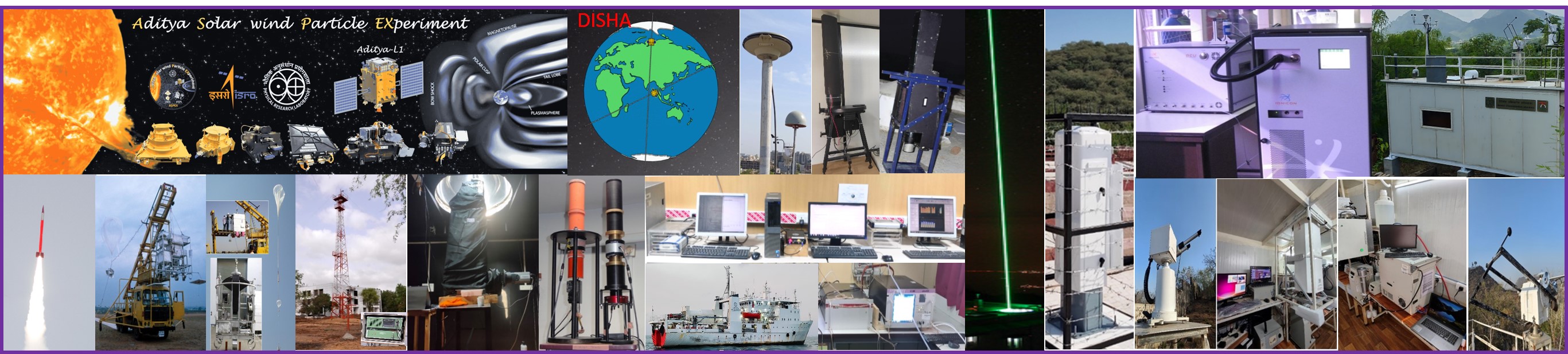
The research in this area pertains to studies of physicochemical and radiative processes in the lower atmosphere, tropospheric-stratospheric interactions, and middle-atmospheric dynamics. High quality and outstanding research with focus on characterisation of atmospheric aerosols, their spatial and temporal variations, their linkages with physical, chemical and dynamical process and their impact on environment, radiation budget, radiative forcing and climate are conducted through state-of-the-art observations and modelling. Comprehensive measurements and modelling of ozone, volatile organic compounds (VOCs) and other trace gases, cloud characteristics and boundary layer dynamics are being conducted. SPASC faculty lead the ISRO's Atmospheric Trace Gases-Chemistry, Transport, and Modelling (AT-CTM), and serve as Principal Investigator in the National Carbonaceous Aerosols Programme (NCAP) Carbonaceous Aerosol Emissions, Source apportionment and Climate impacts (COALESCE) under the Ministry of Environment, Forests, and Climate Change, and provide the technical support to the National Clean Air Program.
Current research topics
1. Atmospheric Aerosols: Characteristics, and Radiative Impact through observations and modeling: The objectives are to characterize the different aerosol types in the atmosphere, document their spatial, temporal and altitudinal variations, understand and examine their linkages with physical, chemical and dynamical processes, and investigate their impact on environment, radiation budget, radiative forcing and climate through high quality, state-of-the-art observations, and modelling.
2. Atmospheric Clouds and Boundary Layer: PRL has initiated Lidar network programme over the Indian region for the investigations of the cloud cover, vertical and layered structures of clouds, and Atmospheric Boundary Layer (ABL) which is the lowest layer in the troposphere and is highly variable temporally, regionally and seasonally and also works as packing volume of the atmospheric pollutants. The studies would be invaluable in the context of Earth's radiation budget as well as the hydrological cycle.
3. Emissions and Photochemistry governing tropospheric ozone: The emissions and atmospheric processes influencing the ambient concentrations of various trace gases, such as CO, NOx, methane, VOCs, etc. are investigated in different environments (urban, suburban, coastal, remote forest, oceanic, etc.) of India employing well-resolved in-situ measurements. The main objective is to understand the relative contributions of anthropogenic, biogenic, and biomass-burning sources to abundance of trace gases, and to assess atmospheric reactivity and ozone formation potential of VOCs.
4. Biomass burning and climate change: The influences of biomass-burning emissions on regional air quality are being investigated. The long-term objective is to quantify the feedback between biomass-burning and climate change and to segregate the role of human-led fires.
5. Air-Sea Exchange of Trace Gases: The transport and air-sea exchange of VOCs over the northern Indian Ocean is being investigated. The spatial and temporal variations of VOCs in the marine air is analyzed comprehensively in the context of the changes in key meteorological and sea surface physical parameters. The contributions of continental transport and oceanic emissions and their role in atmospheric chemistry over the Arabian Sea and Bay of Bengal is being studied. A recent focus has been to study the air-sea exchange of reduced sulfur compounds (e.g., DMS) along with VOCs and their photo-oxidation in the marine air masses of the northern Indian Ocean.
6. Atmospheric modelling and AI/ML: The main objective of atmospheric model simulations is to understand the roles of key physical, chemical, and dynamical processes governing the distributions and impacts of trace gases, VOCs, and aerosols over the Indian Subcontinent. Simulations include the radiative transfer, photochemical box, and regional chemistry-transport models. Dispersion and inversion modeling techniques are further employed to utilize observations for estimating emission fluxes.
As a new initiative, long-term systematic observation and model simulation data are being used to train the AI/ML algorithms for accurate and computationally inexpensive simulations. Most of the model works are being performed using the PARAM Vikram 1000 HPC facility of PRL.
7. Middle atmospheric wave dynamics: Investigations are being carried out to understand critical dynamical processes, e.g., wave-wave interaction, wave-mean flow interaction, wave driven changes in the ambient atmosphere, impact of the waves on the large-scale atmospheric disturbances etc. with the help of ground-based radar, lidar, airglow and satellite-based observations.
Projects funded by ISRO/DOS or other agencies
- Atmospheric Trace Gases- Chemistry, Transport and Modelling (AT-CTM) (funded under ISRO GBP, Ongoing)
- Aerosol Radiative Forcing over India (ARFI) (funded under ISRO GBP, Ongoing)
- Investigations of the Water vapour, Clouds, Boundary Layer, and related parameters using Lidar and Ceilometer over India (funded under ISRO-GBP, ongoing)
- Network of Volatile Organic Compounds (VOCs) Measurements in India: Biosphere-Atmosphere Exchange (funded under ISRO-GBP, ongoing)
Instrument facilities
- Aerosol Chemical Speciation Monitor
- Disdrometer
- Dual wavelength dual Polarization LIDAR
- Flame Ionization Detector
- Gas Chromatographs
- Greenhouse Gas Analysers
- Hygroscopic Tandem Differential Mobility Analyzer
- LIDAR Ceilometer
- Multichannel Raman LIDAR
- Multiwavelength Aethalometer
- Multiwavelength Nephelometer
- Multiwavelength Sun photometer
- Multiwavelength Radiometer
- Proton-Transfer-Reaction Time-Of-Flight Mass Spectrometer (PTR-TOF-MS)
- Pyranometer
- Pyrgeometer
- Pyrheliometer
- Rayleigh LIDAR
- Rocket and balloon borne sensors
- Single Particle Soot Photometer
- Trace Gas Analysers for O3, NOx, CO, SO2, etc.
- Sulfur Trace Gas Analyzer
- Thermal Desorption-Gas Chromatography-Flame Ionization Detector/Mass Spectrometer Detector (TD-GC-FID/MSD)
- VOC Analysers