Evolution of solar system
Dr. K. K. Marhas
Physical Research Laboratory
Ahmedabad
Origin and early evolution of the solar system has remained one of the most intriguing question for a long time. Numerous experimental and theoretical approaches have been employed to seek an unequivocal answer to this question. The progress in experimental techniques and computing capabilities in the last few decades has led to significant advances in this area of research. Owing to unique chemistry and nearly pristine nature, meteorites constitute the most important accessible component of solar system material that may be analyzed to unfold the story of the origin and early evolution of the solar system.
The most widely accepted model for the formation of the solar system suggests that the gravitational collapse of a dense molecular cloud fragment about 4.56 Ga ago led to the formation of the proto-sun at its center and a rotating disk of gas and dust, the so called solar nebula, surrounding the nascent sun. The solar system objects (planets, satellites, comets and asteroids) formed out of this nebula in a gradual manner starting with the formation of grains that coagulated to form larger-sized objects that evolved to planetesimals and finally to planets through gravitational interactions and collisional accretion processes. Some of the frequently asked questions related to the formation and early evolution of the solar system are:
(i) Nature of the initial mix of material characterizing the solar nebula,
(ii) Event(s) leading to the collapse of the proto-solar molecular cloud,
(iii) Timescales of formation of the Sun and some of the first solar system objects,
(iv) Environment and the physical and chemical processes governing the formation of
the first solar system solids.
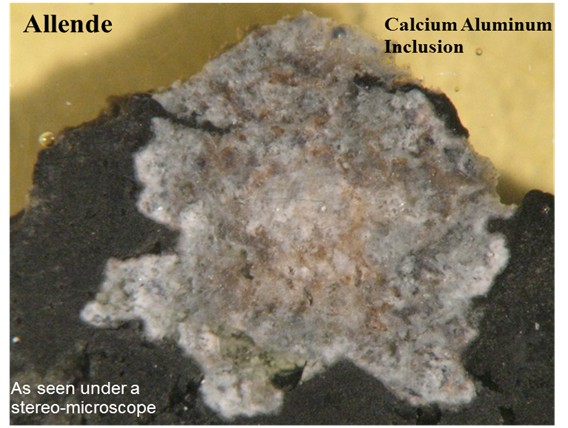
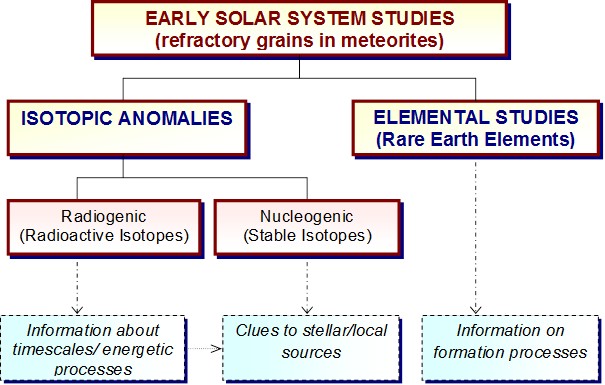
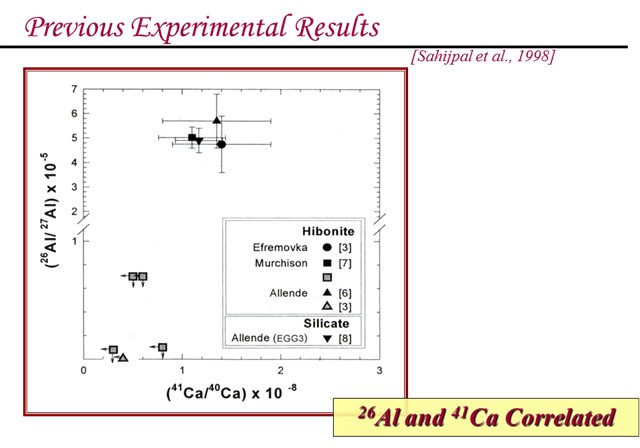
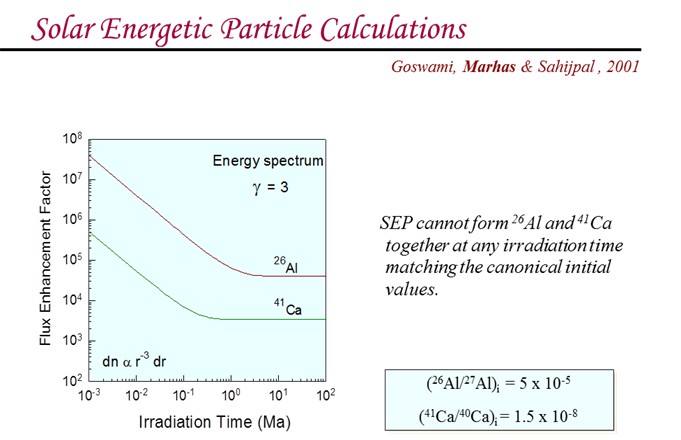
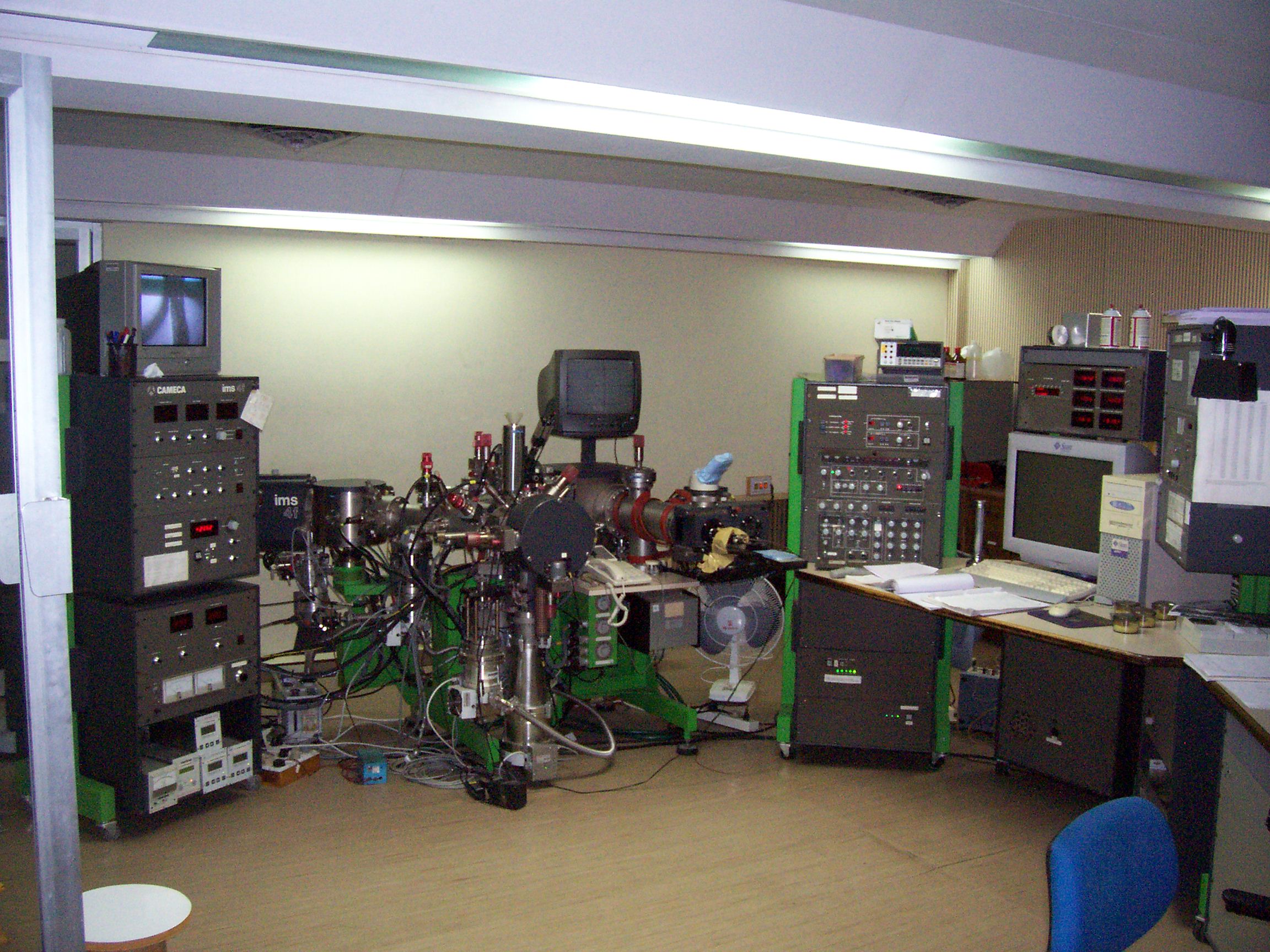
Experimental records that provide clues to the above issues are expected to be present in the first solids that formed in the solar system. It is now known that some primitive meteorites indeed contain such objects known as Calcium Aluminum Inclusions (CAIs). Identification of such early formed solar system objects and study of their isotopic and elemental compositions using ion microprobe technique allows us to respond to some of the above raised queries.
Meteorites and Early Solar System Objects
Meteorites are broadly classified into three groups: stony, stony-iron and iron. These groups are further classified into various other sub-groups. The stony meteorites are grouped into two classes, chondrites and achondrites, the latter being fragments of planetesimals (asteroids) that underwent melting, differentiation and re-crystallization. Stony meteorites of martian origin (SNC group) and of lunar origin have also been detected. The three main types of chondritic meteorites are carbonaceous, ordinary and enstatite chondrites. Seven different classes of carbonaceous chondrites have been identified based on their chemical, petrologic and oxygen isotopic characteristics. These are designated as CI, CM, CV, CK, CO, CH and CR meteorites.
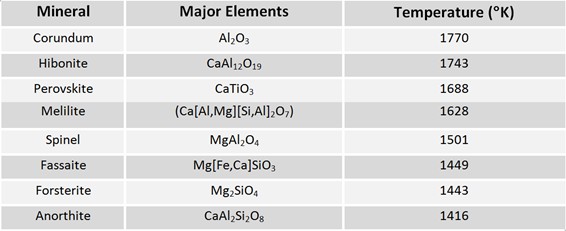
Most of the carbonaceous meteorites escaped extensive thermal metamorphism on their parent asteroids and are considered to be primitive sample of solar system matter. For example, the chemical composition of the CI meteorites closely resembles that of the solar photosphere indicating their pristine nature. Most of the carbonaceous meteorites contain some rare objects composed primarily of refractory oxides and silicates. These refractory objects are referred as CAIs (Calcium-Aluminum-rich Inclusions). The commonly found refractory phases in CAIs are spinel, melilite, pyroxene and anorthite along with minor amount of hibonite, perovskite, corundum, grossite, diopside and forsterite. Few CAIs have also been identified in ordinary and enstatite chondrites. Thermodynamic and petrographic considerations (Grossman, 1972, 1980; Yoneda and Grossman, 1995) suggest CAIs to be some of the first objects to form in the solar nebula as the mineral phases present in CAIs match the first condensates expected during cooling of an initially hot solar nebula (Table 1.1).
Table 1.1 Condensation temperature of refractory minerals at 10-3 atm in the solar nebula (Yoneda and Grossman, 1995).